Verification methodology
A practical verification standard for consequential AI-generated work
A transparent, bounded framework for deciding what an AI-generated work product must establish before it can move downstream.
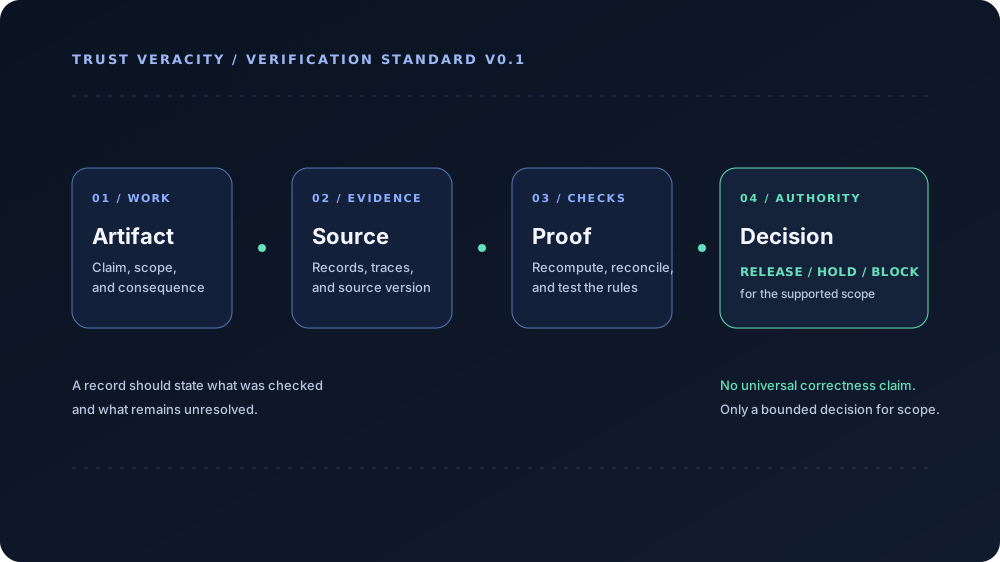
A verification system should not begin by asking whether a model is generally reliable. It should begin with the work that is about to matter: a report, financial model, regulatory filing, operational summary, recommendation, or structured payload. The control question is what this specific work must establish before it can be shared, filed, exported, or used downstream.
The five questions in a useful verification record
- What work is under review? Identify the artifact, supported claims, scope, and intended downstream use.
- What evidence is authoritative? Name the source records, documents, queries, calculations, or execution traces against which the supported claims are checked.
- Which properties were established? Record the explicit checks that ran, such as recomputation, reconciliation, freshness, schema, scope, or policy checks.
- What remains uncertain? Distinguish an unsupported proposition, an unavailable source population, and a judgment that still requires a person. A citation alone is not proof.
- What decision follows? Apply the workflow requirement as Release, Hold, or Block for the supported scope—not as a universal statement that the entire artifact is correct.
Synthetic verification fixtures
These small fixtures are authored by Trust Veracity to make the framework concrete. They use fictional records and are not customer data, benchmark performance, or evidence that every workflow can be verified automatically.
| Work product | Evidence | What was established | Decision |
|---|---|---|---|
| Financial model | Ledger extract + formula inputs | Recomputed margin matches the supported claim | Release |
| Portfolio summary | Point-in-time extract | Population completeness is not established | Hold |
| Regulatory filing | Approved source text + filing rules | Required disclosure is absent | Block |
| Executive memo | Source documents + cited claims | Claim is supported; materiality still needs judgment | Hold |
| Structured payload | Schema definition + policy rules | Required field is missing | Block |
| Operating report | System-of-record table | Values and reporting scope reconcile | Release |
Evidence must be independently connected to the claim
A producer can state that a number came from a source without establishing that the source supports the number. A verification record should preserve the relationship it actually checked: the source version, relevant location, calculation or transformation, scope, and resulting property. When the required relationship cannot be established, the correct outcome is uncertainty—not manufactured confidence.
Hold is a successful control outcome when the required proof is not established.
Correctness and completeness are separate questions
A verification check can establish that the values it examined are correct while leaving open whether the relevant population or required information was complete. A financial calculation may reconcile for the rows provided while the extract omits a material set of records. A filing may contain supported statements while missing a required disclosure. The record should say which proposition was checked and whether the relevant population or obligation was established.
What this standard does not claim
This framework does not claim universal correctness, eliminate the need for human judgment, or treat deterministic checks as proof of a proposition they were not designed to test. It is a method for making bounded evidence, explicit checks, uncertainty, and authorization visible at the release boundary. The appropriate checks and release requirements depend on the workflow, evidence, consequence, and authority involved.
Version and scope
Trust Veracity Verification Standard · v0.1 · September 21, 2026
This is an original Trust Veracity operating framework, published for public review and iteration. It is a conceptual standard, not a certification, audit opinion, regulatory determination, or claim that every workflow can be verified automatically. See the AI verification and release-control guide and release-boundary walkthrough for the product model.